
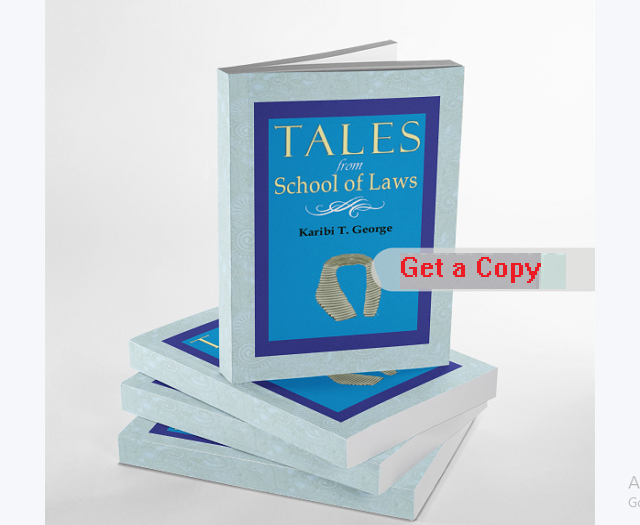
TALES FROM SCHOOL OF LAWS
Reviewed by James Sogulu Noble, PhD, BL.
Taking up the task of reviewing a book authored by my former teacher (lecturer), under whose tutelage I was exposed to the philosophical foundation of language and literature is not an easy task. More so, for a man whose fidelity to the rules of English grammar is enviably intimidating. Reviewing the work of Karibi George – a certified teacher, man of letters, advertising practitioner, lawyer and mediator, and a fellow of the Nigerian Institute of Public Relations is indeed a privilege. Perusing the book creates a nostalgic feeling in me as I was once a “character” in the setting of the book – Nigerian Law School, Agbani, Enugu State.
Tales from School of Laws is a collection of anecdotes of real life experience, written in the epistolary pattern. The letter format is a free form of writing, more accommodating in its scope and renders possible the inclusion of certain details, taking certain liberties and showing a person to person form of contact and communication. In this format, the audience addressed is familiar, distinct, identified and present.
The book is divided into 15 chapters in the form of short letters and an epilogue. This is probably to remind the readers of the days of old, when writing letters to parents, relations and friends from school was the hallmark of studentship. In Tales from School of Laws, the author narrates the genesis of his admiration for the legal profession. His first and second shots at gaining admission to study law, even with a master’s degree in Oral Literature could not secure him admission. However, about fifteen years later, an interplay of circumstances spurred him on, and his interest to study law was rekindled. It is this interest that he pursued earnestly that forms the bedrock of his journey to be called to the Nigerian Bar. The book is a synopsis of the experiences of the author between 31st March, 2006 and 17th May, 2007.
In letter (Tale) I – Hello Folks, the author gives a vivid description of the milieu and ambience of the Augustine Nnamani Campus of the Nigerian Law School, Agbani, Enugu State, where he went in search of the golden fleece of Barrister-at-Law. The letter captures appellations and shapes of the hostel blocks, such as Adam and Eve, and Snake Island; the relatively inexpensive food; the availability of religious activities; fair provision of electricity; and cyber café. More warming to the author seems to be the availability of DSTV-decoder served television set, where he watches premiership and champions’ league football matches.
School of Laws, which is the title tale in Letter 2 chronicles some of the rules guiding students’ stay on campus. These include rules on visiting, use of electricity appliances, abhorrence of fisticuffs, dress code, signing of attendance register for lectures, drunkenness, stealing, walking across grass lawns, urinating on the road and other conducts incompatible with the noble profession of law. The author narrates how they basked in their welcome cocktail party. He describes the dance moves of a female student during the party as offensive to the fragile sensibilities of other students, and wondered how “Coke and Fanta could produce that level of unabashed pelvic and waist dance”. Letter 3 – Medical Concerns is actually an addendum to letter 2 which catalogues the various medical examinations each student undergoes before being admitted into the hostel. The ages, social and traditional status of some students accentuate the fact that Law School is an equalizer.
Taxonomical Creativity – Letter 4 comes with detailed description of the author’s first of the three mandatory dinners, where table etiquette was apprehensively observed. The author discloses that, to some cynical students, the solemnity and formality of the dinner had the veneer of “initiation” ceremony. The taxonomies or nicknames students create for people, items or situations appear interesting to the author: such as Adam and Eve for shape of hostel, Aki and Pawpaw for Marshalls, Federal, State and Local Government for the different cafeteria on campus, depending on the cost of food.
In letter 5, the author unveils the Reactions and Responses that trailed his letters. The tale begins with accounts of the mandatory court attachment programme meant to enable students sharpen their understanding of the Justice system. This period provided the author time to examine the reactions and responses his letters had elicited so far. The author reveals that while some of his friends doubted the veracity of the stories, inferring that as one who is well schooled in English language and Literature, he was merely expressing his creative imagination at fiction, other friends believed the stories he told.
The author in Letter 6 combines his Court Attachment experience and the Familiar Changes he noticed after his return to campus. The author chronicles the activities at the High Court in Port Harcourt where he served, the father figure posture of the judge under whom he served, the lectures arranged for him and his colleagues by the judge, and the groups photo session that signaled the end of the Attachment Programme. On his return to campus the author is awed by the new physical look of the campus, combined with the increased academic work with the addition of hours of tutorial.
In Letter 7 – Practice Week Ordeal, the author expresses his delight for having the opportunity to dine with two eminent female Law Lords during the second mandatory dinner, clamming “I am really blessed among women”. He describes in vivid terms the length of hours spent during the lectures and Moot Trial Sessions, dissecting criminal and civil procedures spanning over five and sometimes nine hours. For the author, the week should be tagged week of ordeal instead of practice week as christened in the school calendar.
Court Down, the title of Letter 8, appears to be an extension of the Practice Week. In it the author re-echoes the strictness of the laws in the Law School; where the author once as a compere of a religious programme had the unsavory task of announcing the abrupt stoppage of the programme, because the regulation of the school prohibits religious and social activities from holding beyond 7:30 pm. For the author, the most telling lesson here is on “the need for children of God to have respect for time”.
In Letter 9 – Last Lap, the author continues the story of his journey to obtaining the golden fleece of Call to the Nigerian Bar. He reveals the tightly scheduled exam, the religious angle to the preparation and how as the day drew near the smell of the examination became more palpable. The author’s description of the Head of Campus’ address to the students may seem hyperbolic when he quoted the DDG to the effect that “to even dream, smell or taste question paper or promoting unfounded rumour about the exam may be construed as examination malpractice”. In this letter also, the author describes the presence of Resit Students on Campus as depressing, and a grim reminder of the battle ahead of him and other students, as they prepared for the Bar Final Exams.
After Everything, the author expresses in letter 10 and 11 his excitement, and like the metaphorical Agama Lizard, he nods his head in acknowledgement of his preparation for the exams, the good health he enjoyed throughout the period and the cocktail party marking the end of his one year intellectual peregrination at Agbani, Enugu State. In fact, the author’s account of the send-off party eloquently explains the excitement, pomp and panoply associated with such after “Last Paper” parties and rituals.
Letter 12 – Outstanding Victory appears very significant to the author and his readers. It is the culmination of all worked in the last year. His fears, hopes and expectation had been crowned with his superlative performance at the Bar Finals, earning him a second class upper grade (2.1). To this, the author gives glory to God and appreciates all those who morally and materially supported his academic adventure.
Tale of Two Books in Letter 13 relates the processes leading to the Call to Bar ceremony itself. The setting moved from Agbani, Enugu State to Bwari, Abuja, where the author, like his colleagues, presented requisite documents for screening and clearance. Just like the letter on “taxonomical creativity,” the two different sheets of paper which the verification officers use in determining those to be cleared or those not to be cleared are labeled “Book of Life” and “Book of Death”. The author’s veiled invitation to friends in these words “…there is no obligation upon you to attend the ceremony” could positively be likened to Antonio’s letter to Bassanio in William Shakespeare’s Merchant of Venice”.
Tale of a Call in Letter 14 is the apogee of the tales from Karibi George. This letter which tells the author’s Call to the Nigerian Bar on May 8, 2007 unveils even the minutest detail of a Call to Bar ceremony; where professional discipline is massaged in every material particular into the legal body frame of new wigs. The very interesting part of the author’s revelation is the dinner that followed the Call, where the high and mighty in the legal profession partook in the dinner with the new wigs to the exclusion of guests, often perceived by non-lawyers as “initiation” ceremony. What accentuates the author’s joy the most appears to be the presence of his wife and parents at the Call to Bar ceremony, taking to the climax his fulfilled dream of becoming a Solicitor and Barrister of the Supreme Court of Nigeria.
There is no better way to end the Tales from Schools of Laws than to proffer possible antidote for the malaise of fear and ill preparation at the Nigerian Law School. The author in his epilogue prescribes tips for coming out successful in the Bar Finals; exposing the secret to his success in the Exams, and encouraging would be candidates to arm themselves with the tips. The Epilogue catalogues 21 necessary tips and emphasizes the importance of making summaries, reducing all the vast materials into manageable size for easy recall. This, in the opinion of the author assists students, but he disagrees with the manner some people hail summaries as though summaries provide absolute panacea for all academic defects.
Tales from Schools of Laws positively betrays the creative energy of the author, whose narrative, expository and analytical skills are uncovered through the use of suitable adjectives, phrases and literary devices that convey his inner joy in being in the Nigerian Law School in pursuit of his dream.
The author’s elegant presentation of his stories affirms his mastery of this genre of literature, with his occasional authorial intrusion into the minds of his colleagues and lecturers. His use of humour in telling his stories is another pointer to the fact that the author though studying seriously as a “mature” student thoroughly enjoyed the entire programme. The application of literary devices in expressions such as “smell of exam” “mental legs”, “moving head like wiper”, “like the staple chase event athlete” and many more are all mountainous evidence of the author’s good literary craftsmanship.
In all, Tales from School of Laws by Karibi George is a book for relaxation for every reader. While it will create a feeling of nostalgia in every Lawyer who had passed through the Nigerian Law School, especially the Enugu Campus, it will create a sense of anxiety and expectation in Law graduates who may be waiting to enroll in the Nigerian Law School. “And to the non-initiates”, non-lawyers, they will understand better what a lawyer goes through to adorn the wig and gown.


